

NICE AUTOMATION UAE
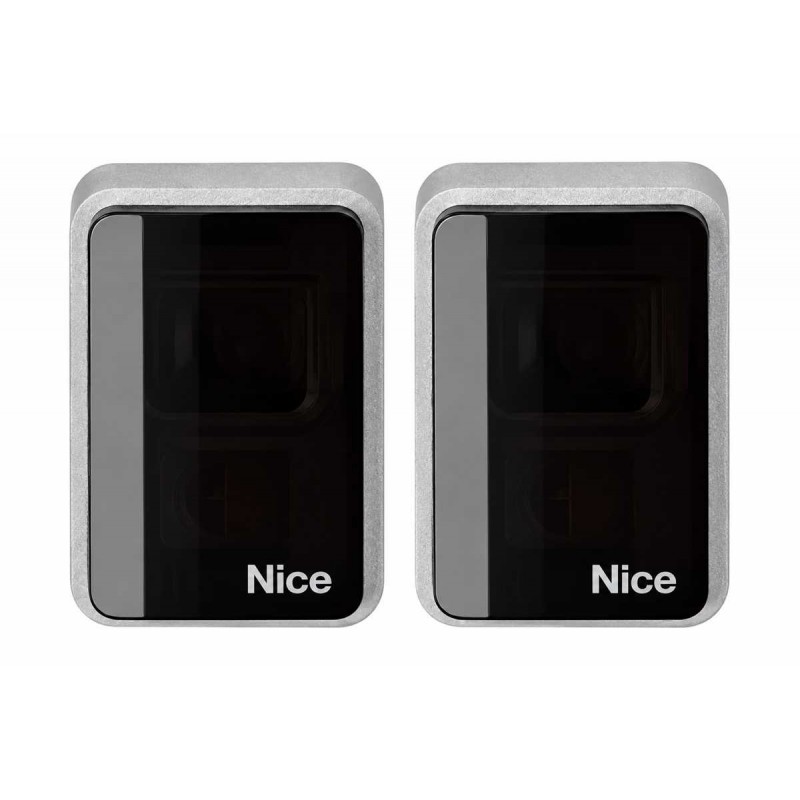
NICE EPMB BlueBUS Gate Photocell Safety Sensors – 15 M
Genuine NICE Product
UAE Delivery
Technical Support
Price 200 AED In Stock
NICE EPMB Two-Wire BlueBUS Gate Safety Photocells UAE
The NICE EPMB Era BlueBUS Photocell Sensors are a genuine NICE pair of infrared safety photocells designed for compatible automatic sliding gates, swing gates, parking barriers, garage doors and other NICE automation systems using BlueBUS technology.
The EPMB system consists of one TX transmitter and one RX receiver installed opposite each other across the protected passage. The transmitter creates an infrared beam and the receiver continuously monitors it. When a vehicle, person or other obstacle interrupts the beam, the EPMB sends the corresponding safety information through the BlueBUS network to the automation control unit.
Unlike conventional photocells that require separate power and relay wiring, the NICE EPMB uses only two BlueBUS wires for both power supply and digital communication. BlueBUS devices are connected in parallel, polarity does not need to be observed, and each photocell pair is identified by its assigned jumper address during the control unit learning procedure.
NICE EPMB Key Features
- Original NICE Era BlueBUS photocell pair
- Official model: EPMB
- TX transmitter + RX receiver
- Infrared obstacle detection
- NICE BlueBUS two-wire connection
- Power and communication through the same two wires
- No polarity requirement on BlueBUS connection
- Devices connected in parallel
- Addressable through configuration jumpers
- Nominal range up to 15 m
- Maximum TX-RX angular offset approximately ±5°
- Obstacle signalling designed to remain reliable in adverse weather conditions
- Automatic synchronisation through BlueBUS architecture
- IP44 protection rating
- Operating temperature -20°C to +55°C
- Compact 50 × 29 × 80 mm housing
- Approx. 140 g per pair
- Compatible with suitable NICE BlueBUS automation controllers
NICE EPMB Technical Specifications
| Brand | NICE |
| Series | Era Photocell M |
| Model | EPMB |
| Product Type | BlueBUS Infrared Safety Photocell Pair |
| Components | 1 × TX Transmitter + 1 × RX Receiver |
| Connection Technology | NICE BlueBUS |
| Wiring | 2 Wires for Power and Communication |
| Polarity | Not Required on BlueBUS |
| Power Supply | From Compatible NICE BlueBUS Network |
| Output | Digital Communication Through BlueBUS |
| Estimated Range | Up to 15 m |
| Maximum TX-RX Offset | Approx. ±5° |
| Photocell Adjustment | Fixed |
| Protection Rating | IP44 |
| Operating Temperature | -20°C to +55°C |
| Dimensions | 50 × 29 × 80 mm |
| Weight | Approx. 140 g per Pair |
What Is NICE BlueBUS?
BlueBUS is NICE's two-wire communication system for compatible automation accessories.
Instead of providing separate wiring for accessory power and command signals, compatible devices share the same two BlueBUS conductors.
This simplifies installation and allows the control unit to identify connected devices individually after the appropriate learning procedure.
Only Two Wires Required
One of the main advantages of the NICE EPMB is the simplified two-wire BlueBUS connection.
The same pair of conductors carries both electrical power and communication data.
This can significantly reduce wiring complexity compared with conventional photocells that require dedicated supply conductors plus relay-output wiring.
No Polarity Requirement
NICE BlueBUS devices can normally be connected without observing polarity on the two BlueBUS conductors.
This can make installation quicker and reduce wiring errors.
BlueBUS Devices Connected in Parallel
Compatible BlueBUS devices are connected in parallel on the same two BlueBUS wires.
The control unit then recognises the devices during its learning procedure.
Photocell Addressing
When several EPMB photocell pairs are installed, each TX and RX pair must be assigned the correct BlueBUS address using the internal configuration jumpers.
The transmitter and receiver belonging to the same photocell pair must use the same address configuration.
Two different pairs should not be assigned the same address unless specifically required by the control-unit installation instructions.
Control Unit Learning Procedure
After adding, removing or changing the address of an EPMB photocell, the compatible NICE control unit must normally perform a BlueBUS device learning procedure.
This allows the controller to identify the connected photocells and assign their intended safety functions.
15 Metre Detection Range
NICE specifies an estimated detection distance of up to 15 metres for the EPMB pair.
This is suitable for most residential driveways, sliding gates, swing gates, parking barriers and commercial entrances.
Maximum TX-RX Offset ±5°
The official NICE technical specification states that the EPMB maintains its rated operating range with a maximum transmitter-to-receiver offset of approximately ±5°.
Correct physical alignment remains essential for reliable operation.
Infrared Obstacle Detection
The TX unit transmits an infrared beam toward the RX unit.
If the beam is interrupted, the EPMB informs the control unit through the BlueBUS network.
The Control Board Determines Gate Behaviour
The photocell itself does not directly reverse the motor.
It reports the obstacle condition to the automation controller.
The controller then determines the safety response according to the photocell address and programmed function.
Depending on the system, the response may include:
- Preventing gate closure
- Stopping movement
- Reversing movement
- Reopening the gate
- Stopping during opening
- Restarting after the beam becomes clear
Photocell Function Depends on BlueBUS Address
BlueBUS allows the automation controller to distinguish between photocells positioned in different safety zones.
For example, depending on the control unit and installation layout, photocells may be configured as:
- FOTO
- FOTO 1
- FOTO 2
- Internal photocell
- External photocell
- Opening safety photocell
- Closing safety photocell
Always follow the exact control-unit manual for the permitted jumper addresses and resulting safety behaviour.
Automatic Synchronisation
Nice BlueBUS architecture helps manage multiple photocells and is designed to prevent optical interference between correctly installed photocell pairs.
This makes multiple-sensor installations easier than conventional independent photocell systems.
NICE EPMB Is Not EPM
This distinction is very important.
NICE EPMB = BlueBUS digital photocell.
NICE EPM = conventional photocell with separate power supply and relay output.
The two models should not be described as electrically interchangeable.
NICE EPMB vs EPM
| Feature | NICE EPMB | NICE EPM |
| Technology | BlueBUS | Conventional Wired |
| Connection | 2 BlueBUS Wires | Separate Power + Relay Wiring |
| Power Supply | From BlueBUS Network | Selectable External AC/DC Supply |
| Safety Output | Digital BlueBUS Communication | Relay Contact |
| Polarity | No BlueBUS Polarity | According to Wiring Requirements |
| Nominal Range | Up to 15 m | 15 m |
| Protection | IP44 | IP44 |
Do Not Use Conventional EPM Specifications on EPMB
Do not copy the following EPM specifications onto the EPMB page:
- 12V / 24V AC/DC selectable supply
- 25 mA RX / 30 mA TX figures
- 500 mA / 48V relay-output specification
- COM / NC / NO wiring
Those specifications belong to conventional photocell versions and are not the correct way to describe the BlueBUS connection of the EPMB.
EPMB with NICE ROBUS
The EPMB is commonly used with compatible NICE ROBUS sliding gate control units equipped with BlueBUS.
NICE also supplies EPMB photocells in current ROBUS kit configurations, confirming the model as a standard BlueBUS safety accessory for suitable ROBUS systems.
EPMB with New ROBUS RBS Series
The EPMB is particularly suitable for current NICE ROBUS BlueBUS systems such as compatible RBS-series installations.
After connection, the control unit must learn the EPMB device according to its installation procedure.
EPMB with Older RB600 / RB1000 Systems
Older NICE ROBUS control units such as compatible RBA3-based systems also use BlueBUS and can work with suitable BlueBUS photocells.
The exact control-board manual should still be checked before installation.
EPMB with NICE RUN
Compatible NICE RUN sliding gate controllers supporting BlueBUS can use EPMB photocells as part of their safety system.
EPMB with NICE MC824H
The NICE MC824H is a 24V control unit with BlueBUS device support.
EPMB is therefore the correct connection family for standard BlueBUS photocell installation on compatible MC824H systems.
EPMB with NICE TOONA
For NICE TOONA 24V motors controlled by an MC824H or another suitable BlueBUS controller, EPMB photocells can be integrated through the controller's BlueBUS terminals.
The motor itself does not determine photocell compatibility—the control unit does.
EPMB with NICE WINGO
Compatible NICE WINGO installations using a BlueBUS-capable control unit can use EPMB photocells.
Do not claim universal compatibility with every WINGO kit because some control-unit generations use conventional safety inputs instead.
EPMB with NICE Parking Barriers
Many current NICE parking barrier controllers support BlueBUS safety devices.
Where supported, the EPMB can detect a vehicle or obstacle across the protected beam and send the corresponding safety status to the barrier controller.
EPMB Is Not a Vehicle Loop Detector
Photocells and inductive vehicle loops serve different purposes.
EPMB detects interruption of an infrared beam.
A loop detector senses a vehicle through an inductive loop installed in the road surface.
For many parking-barrier installations, both technologies may be used together as part of the complete access and safety design.
Sliding Gate Safety Application
For a sliding gate, one EPMB pair can be installed across the driveway to monitor the closing area.
Additional photocells may be required depending on gate geometry, opening hazards and the overall safety assessment.
Swing Gate Safety Application
Swing gates can create several potential hazard zones because the leaves move through an arc.
BlueBUS addressing allows multiple photocells to be assigned different safety roles where supported by the controller.
Parking Barrier Safety Application
The EPMB can be installed across the vehicle lane to monitor the area beneath or near a barrier arm.
The exact response during beam interruption depends on the barrier control-unit programming.
Garage Door Safety Application
Compatible NICE garage-door controllers with BlueBUS support can use the EPMB where the product manual allows external BlueBUS photocells.
IP44 Outdoor Protection
The official NICE technical specification gives the EPMB a protection rating of IP44.
This makes it suitable for correctly installed outdoor gate applications.
Do not describe the unit as fully waterproof or submersible.
Operating Temperature -20°C to +55°C
NICE's current technical catalogue lists an operating range of -20°C to +55°C for EPMB.
This is the value I recommend using on your page.
Suitable for UAE Gate Installations
The EPMB can be used in UAE gate automation when installed within its specified environmental limits and according to NICE instructions.
For exposed outdoor locations, ensure:
- Correct mounting
- Proper cable entry
- Secure covers
- Stable posts
- Clean optical surfaces
- Protection from physical impact
50 × 29 × 80 mm Dimensions
The official EPMB dimensions are approximately 50 × 29 × 80 mm.
This compact format makes the photocells suitable for gate pillars, walls and compatible NICE photocell posts.
140 g Pair Weight
The official listed weight is approximately 140 grams for the pair.
EPMB Is a Fixed Photocell
The standard EPMB is a fixed optical photocell.
If greater optical adjustment is required, NICE provides separate orientable BlueBUS variants.
NICE EPMB vs EPMOB
| Feature | EPMB | EPMOB |
| Technology | BlueBUS | BlueBUS |
| Nominal Range | Up to 15 m | Up to 15 m |
| Optical Adjustment | Fixed | Approx. 30° on all axes |
| Dimensions | 50 × 29 × 80 mm | 50 × 38 × 80 mm |
| Weight | 140 g | 160 g |
NICE EPMB vs EPMAB
The EPMAB is the BlueBUS anti-intrusion / more robust metal-body version, while EPMB is the standard compact housing.
If additional physical protection against impact or tampering is required, use the actual EPMAB model rather than describing EPMB as an anti-vandal metal photocell.
NICE EPMB vs EPMORB
The EPMORB uses BlueBUS with a reflective photocell arrangement and reflector, while EPMB uses a conventional TX and RX pair positioned opposite each other.
Choose the photocell type according to site wiring and installation geometry.
Installation Alignment
TX and RX must be mounted facing each other with a clear optical path.
After physical installation, verify:
- Correct vertical alignment
- Correct horizontal alignment
- Stable mounting
- No vegetation blocking the beam
- No excessive angular offset
- Reliable detection when the beam is interrupted
BlueBUS Wiring Procedure
A typical installation involves:
- Disconnecting power to the automation.
- Mounting the TX and RX units.
- Setting matching address jumpers on the TX and RX pair.
- Connecting both units to the BlueBUS two-wire network.
- Restoring power.
- Running the control unit's BlueBUS device learning procedure.
- Testing photocell response during gate operation.
No COM / NO / NC Terminals
Do not describe EPMB wiring using conventional COM, NO and NC relay terminals.
The EPMB communicates digitally through BlueBUS.
If a control board only provides conventional photocell relay inputs, use the correct conventional photocell model or an approved NICE interface where applicable.
Gate Does Not Move After EPMB Installation
If a gate stops operating after EPMB installation, check:
- BlueBUS wiring continuity
- Correct jumper addresses
- Matching TX and RX address
- Photocell alignment
- Control-unit BlueBUS LED
- Whether device learning was completed
- Whether another pair has the same address
Gate Closes with Photocell Beam Blocked
If the safety response is incorrect, check the BlueBUS address assigned to the photocell and the control unit's programmed logic.
The safety behaviour depends on the photocell function recognised by the control unit.
Photocell Works in the Wrong Gate Direction
If a photocell appears to operate during the wrong direction of movement, do not swap the TX and RX units expecting the safety logic to reverse.
Verify the BlueBUS jumper address and control-unit configuration.
Intermittent Photocell Fault
Intermittent EPMB problems can be caused by:
- Incorrect alignment
- Excessive TX-RX offset
- Loose BlueBUS connections
- Water ingress
- Dirty optical covers
- Moving posts
- Damaged cable
- Incorrect duplicate addresses
Cleaning and Maintenance
Periodically inspect and clean the EPMB optical covers.
Check for:
- Dust
- Sand
- Spider webs
- Water or condensation
- Loose covers
- Misalignment
- Damaged mounting points
Safety Testing After Installation
After wiring and learning the EPMB devices, perform a complete functional safety test.
Interrupt the beam during the relevant gate movement and verify that the automation responds according to the intended controller logic.
Photocells should form part of the complete safety design and should not be treated as the only safety measure required for every installation.
Recommended NICE EPMB UAE Package
- 1 × NICE EPMB TX Transmitter
- 1 × NICE EPMB RX Receiver
- Mounting Accessories if Included in Current Factory Box
- Installation Instructions if Included
Photocell posts, BlueBUS cable and professional installation should be listed separately unless physically included in your package.
NICE EPMB Installation UAE
Professional supply, replacement and installation support is available for compatible NICE BlueBUS gate automation systems.
Service is available across Dubai, Sharjah, Abu Dhabi, Ajman, Ras Al Khaimah, Fujairah, Umm Al Quwain and Al Ain.
Why Choose NICE EPMB?
- Original NICE BlueBUS accessory
- Only two wires required
- Power and communication on the same network
- No BlueBUS polarity requirement
- Individual photocell addressing
- Automatic device recognition after learning
- Designed for multiple photocell installations
- Up to 15 m operating range
- Approx. ±5° maximum TX-RX offset
- IP44 protection
- -20°C to +55°C operation
- Compact 50 × 29 × 80 mm housing
- Approx. 140 g per pair
- Suitable for compatible NICE BlueBUS automation systems
Buy NICE EPMB BlueBUS Photocells UAE
Buy the NICE EPMB BlueBUS gate photocell safety sensors in UAE for compatible automatic sliding gates, swing gates, garage doors and parking barriers.
Supply, installation, replacement and technical support are available throughout Dubai, Sharjah, Abu Dhabi, Ajman, Al Ain, Ras Al Khaimah, Fujairah and Umm Al Quwain.
Frequently Asked Questions
What is NICE EPMB?
NICE EPMB is a pair of BlueBUS infrared safety photocells consisting of one TX transmitter and one RX receiver.
What is the operating range?
NICE specifies an estimated range of up to 15 metres.
What is the maximum TX-RX offset?
Approximately ±5° according to NICE technical data.
Is EPMB BlueBUS?
Yes. EPMB is specifically the NICE BlueBUS version.
How many wires does EPMB require?
Only two BlueBUS conductors are required for both power and communication.
Does BlueBUS have polarity?
Compatible NICE BlueBUS wiring does not require polarity to be observed.
Is EPMB a 12V or 24V photocell?
Do not describe EPMB by a conventional external supply voltage. It receives its power directly from the compatible NICE BlueBUS network.
Does EPMB have COM, NO and NC terminals?
No. It sends safety information digitally through BlueBUS rather than using a conventional relay output.
Is EPMB the same as EPM?
No. EPMB is BlueBUS. EPM is the conventional relay-output version.
What is the IP rating?
The official rating is IP44.
What is the operating temperature?
Approximately -20°C to +55°C.
What are the dimensions?
Approximately 50 × 29 × 80 mm.
What is the weight?
Approximately 140 g per pair.
Can EPMB work with NICE ROBUS?
Yes, with compatible ROBUS control units equipped with BlueBUS.
Can EPMB work with MC824H?
Yes. MC824H supports BlueBUS devices and EPMB is the appropriate photocell family for suitable installations.
Can I connect EPMB to a normal photocell input?
Not directly. EPMB requires a compatible BlueBUS network. For conventional relay inputs, use the appropriate conventional photocell model or approved interface.
Why must EPMB be learned by the controller?
BlueBUS devices are individually recognised by the automation control unit, so adding or removing a device normally requires the controller's device-learning procedure.
Do you provide NICE EPMB installation in UAE?
Yes. Installation and troubleshooting support is available for compatible NICE BlueBUS gate and barrier systems throughout the UAE.
Frequently Asked Questions
Is this NICE product suitable for UAE installation?
Yes, this NICE product is suitable for residential, commercial and industrial gate automation applications in UAE when selected according to gate size, weight and usage.
Do you provide installation support?
Yes, installation and technical support is available in Dubai, Sharjah, Abu Dhabi and other UAE locations.
Can I order this product on WhatsApp?
Yes, you can use the WhatsApp order button on this page to request price, availability and delivery details.