
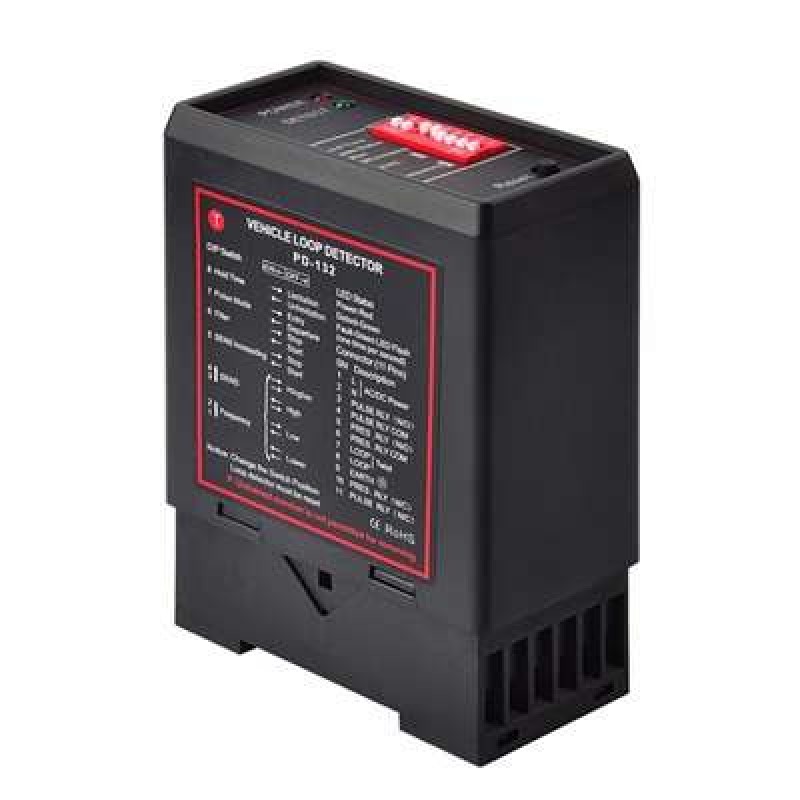
Single Channel Inductive Loop Detector for Parking Barriers & Gates
The PD-132 Vehicle Loop Detector is a professional single-channel inductive vehicle detector designed for parking barriers, automatic gates, bollards and vehicle access-control systems.
This page is for the 230 V AC version of the PD-132. The detector works with an inductive loop installed beneath the roadway and detects a vehicle by monitoring changes in the loop's inductance.
When a vehicle enters the detection area, the PD-132 changes the state of its relay output. This dry relay output can then be connected to a compatible parking barrier, gate controller or access-control system for opening, vehicle-presence or safety logic.
PD-132 Key Features
- Single-channel inductive vehicle loop detector
- Model: PD-132
- Supply voltage: 230 V AC
- Fast 10 ms response time
- Four adjustable sensitivity levels
- Operating frequency: 20 kHz to 170 kHz
- Loop inductance range: 50 μH to 1000 μH
- Recommended loop inductance: 100 μH to 300 μH
- Relay output rated up to 240 V AC / 5 A
- Selectable permanent or limited presence operation depending on configuration
- Suitable for parking barriers and automatic gate systems
- Maximum loop lead length approximately 20 meters
PD-132 Technical Specifications
| Model | PD-132 |
| Detector Type | Single Channel Inductive Vehicle Loop Detector |
| Supply Voltage | 230 V AC |
| AC Voltage Tolerance | +10% / -15% |
| Power Consumption | Approx. 4.5 VA |
| Relay Rating | Up to 240 V AC / 5 A |
| Operating Temperature | -20°C to +65°C |
| Storage Temperature | -40°C to +85°C |
| Frequency Range | 20 kHz to 170 kHz |
| Response Time | Approx. 10 ms |
| Sensitivity | 4 Adjustable Levels |
| Loop Inductance Range | 50 μH to 1000 μH |
| Recommended Loop Inductance | 100 μH to 300 μH |
| Maximum Lead Cable Length | 20 Meters |
| Lead Cable Twisting | Minimum 20 twists per meter |
| Housing Dimensions | Approx. 78 × 40 × 108 mm |
How the PD-132 Loop Detector Works
An insulated loop cable is installed beneath the road surface and connected to the PD-132 detector.
The loop forms an inductive sensing circuit. When a vehicle containing a large mass of metal moves over the loop, the electrical inductance changes.
The PD-132 detects this change and activates its relay output.
Single Channel Vehicle Detection
The PD-132 is a single-channel detector, meaning it monitors one inductive loop.
If an application requires two independent loops, use two single-channel detectors or a suitable dual-channel loop detector such as a PD-232-type unit.
230 V AC Version
This product page should clearly state that it is the 230 V AC version.
Do not combine the 12 V, 24 V and 230 V versions on the same product page because the supply-voltage requirement is different.
PD-132 12 V, 24 V and 230 V Versions
| Version | Supply |
| PD-132 12 V | 12 V version – separate product |
| PD-132 24 V | 24 V version – separate product |
| PD-132 230 V | 230 V AC – this product page |
Do Not Apply 230 V to a 12 V or 24 V Detector
The detector supply voltage must match the exact PD-132 version.
Applying 230 V AC to a low-voltage version can permanently damage the detector and create an electrical hazard.
Four Adjustable Sensitivity Levels
The PD-132 provides four selectable sensitivity levels.
Sensitivity should be set high enough to detect the intended vehicles reliably but not unnecessarily high, which can increase the risk of false detection from adjacent loops or nearby metal movement.
10 ms Response Time
The detector is commonly specified with a response time of approximately 10 milliseconds, allowing quick vehicle detection in gate and parking applications.
Operating Frequency
The PD-132 operates across a frequency range of approximately 20 kHz to 170 kHz.
Frequency selection can help reduce interference where multiple loops are installed close to one another.
Loop Inductance
The supported total loop inductance range is approximately 50 μH to 1000 μH.
The recommended operating region is approximately 100 μH to 300 μH.
Loop Lead Cable
The connection cable between the roadway loop and detector should be twisted to reduce electrical interference.
A commonly specified maximum lead length is approximately 20 meters, with at least 20 twists per meter.
Keep the Detector Close to the Loop
Where practical, install the detector cabinet reasonably close to the loop.
Excessive lead cable length can affect loop inductance and increase susceptibility to interference.
Parking Barrier Opening Application
The PD-132 relay can be used to provide an opening command to a compatible parking barrier controller.
When the vehicle enters the loop, the detector relay changes state and can activate the barrier's OPEN, START or suitable command input.
Parking Barrier Safety Loop
A loop detector can also be used as a vehicle-presence safety device beneath the barrier arm area.
When correctly designed, the control system can prevent or interrupt closing while a vehicle remains over the loop.
Important Safety Note
The exact safety response depends on how the relay is wired and how the parking barrier controller input is programmed.
A loop detector does not automatically create a safe anti-crush system merely by being connected.
The complete installation should use appropriate photocells, safety edges and vehicle-presence devices where required.
Automatic Sliding Gate Application
The PD-132 can be connected to a suitable sliding gate controller to detect vehicles approaching or occupying the gate area.
Typical uses include automatic opening, free exit and vehicle-presence safety.
Swing Gate Application
The detector may also be used with compatible swing gate systems where a vehicle detection loop is appropriate.
Loop placement must consider the complete swing path of both gate leaves.
Bollard Application
PD-132 can be integrated with compatible automatic bollard controllers for vehicle presence or access commands.
Safety logic must ensure that a bollard cannot rise beneath a vehicle.
RFID Vehicle Access Control
A loop detector is often used together with RFID access-control systems.
The loop can indicate that a vehicle is physically present while the RFID system determines whether the vehicle or user is authorized.
UHF Long-Range RFID
For long-range vehicle access systems, the PD-132 can provide presence detection while a UHF RFID reader identifies the authorized vehicle tag.
ANPR Camera Integration
The loop can be used as a trigger or vehicle-presence input in an ANPR access-control system.
The ANPR system can then identify the number plate and provide an authorized opening command through the parking controller.
Free Exit Loop
A common use of the PD-132 is a free-exit loop.
When a vehicle approaches the exit side, the loop detector relay commands the parking barrier or gate to open automatically.
Presence Loop
A presence loop can be positioned under or near the boom area to tell the barrier controller that a vehicle remains in the passage zone.
Entry Request Loop
In ticketing or RFID systems, a loop can be positioned before the reader or ticket machine so the access system only becomes active when a vehicle is present.
Relay Output
The PD-132 provides relay contacts for integration with compatible automation systems.
The relay should normally be used as a control signal, not as the direct power source for a gate or barrier motor.
Do Not Directly Power the Motor Through the Loop Detector
Even though the relay has an electrical contact rating, it should normally command a low-current control input such as:
- OPEN
- START
- SBS / Step-by-Step
- Vehicle Presence
- Safety Input
Do not use the PD-132 relay to directly switch a gate or barrier motor unless the equipment manufacturer specifically designs the circuit that way.
NO and NC Contact Selection
The appropriate normally-open or normally-closed relay contact depends on the intended function.
For example, an opening request normally uses a momentary command input, while a vehicle-presence safety circuit may require different logic.
Opening Only Application
If the loop is intended only to open a gate or barrier when a vehicle arrives, connect the detector relay to the controller's dedicated OPEN input where available.
This is preferable to connecting it to a step-by-step input if you do not want subsequent loop activations to cause stop or close commands.
Automatic Closing
If the system uses automatic closing, configure the gate or barrier controller separately.
The loop detector itself should primarily provide vehicle-detection information to the controller.
Signal Hold Time
PD-132 versions commonly support a permanent-presence mode and a limited-presence mode.
Your live page currently describes this as unlimited hold or approximately 10 minutes when the loop remains permanently occupied.
The selected mode should match the parking application.
Permanent Presence Mode
Permanent presence is useful for safety loops because the relay remains active while a vehicle remains in the detection zone.
Limited Presence Mode
Limited-presence operation can be appropriate for certain traffic-control applications, but it should not be selected casually for a safety loop where a vehicle may remain stationary for an extended time.
Loop Installation
Correct loop installation is as important as the detector itself.
The loop geometry, number of turns, slot depth, lead cable twisting and distance from metal structures all affect performance.
Typical Loop Shape
Vehicle loops are commonly installed as rectangular loops beneath the road surface.
The exact dimensions should be chosen according to lane width, vehicle type and installation conditions.
Loop Cable Turns
The required number of turns depends on loop perimeter and desired inductance.
After installation, verify that the total inductance remains within the detector's supported range, preferably near the recommended 100–300 μH operating region.
Loop Cable Must Not Have Underground Joints
Where possible, use one continuous insulated loop cable through the roadway loop and back toward the lead connection.
Underground joints can allow moisture ingress and create intermittent detection faults.
Twist the Lead Cable
The two lead wires between the loop and detector should be twisted tightly together.
This helps reduce the lead itself acting as part of the active detection area and reduces electromagnetic interference.
Keep Away from High-Voltage Cables
Do not route the loop lead directly alongside high-voltage power cables, motor cables or other strong electrical noise sources where this can be avoided.
Adjacent Loop Interference
When two vehicle loops are installed close together, they can interfere with each other.
Use different detector frequency settings and suitable loop spacing to reduce cross-talk.
Installation Inside a Weatherproof Cabinet
The detector should be installed in a suitable protected enclosure or control cabinet.
Your other PD-132 installation information correctly recommends using a weatherproof location close to the loop and maintaining clearance from heat sources and nearby equipment. :contentReference[oaicite:2]{index=2}
Do Not Describe the Bare Detector as Weatherproof
A bare plug-in PD-132 module should not be marketed as suitable for direct outdoor exposure simply because it is used in outdoor parking systems.
Install it inside a suitable protected control enclosure.
UAE Installation Conditions
The specified operating-temperature range is approximately -20°C to +65°C.
For UAE installations, install the detector inside a properly ventilated and protected control cabinet and avoid excessive heat buildup from direct sunlight or adjacent power equipment.
Remove “Designed for Harsh UAE Weather”
Do not claim that the detector is specially manufactured for UAE heat, dust and humidity unless the actual manufacturer provides that certification.
Use the documented operating-temperature specification and proper enclosure recommendation instead.
Do Not Brand PD-132 as NICE
The PD-132 model name is used by multiple loop-detector manufacturers and suppliers.
It should not be described as a genuine NICE product unless the exact detector, label and manufacturer packaging confirm that branding.
A safer product classification is:
Brand: Generic / Actual Manufacturer
PD-132 vs Nortech PD132
Do not confuse this generic PD-132 with the Nortech PD132 Enhanced Vehicle Detector.
Nortech PD132 is a separate branded professional detector with its own features and specifications.
PD-132 vs PD-232
| Model | Typical Application |
| PD-132 | Single-channel / one-loop vehicle detection |
| PD-232 | Dual-channel / two-loop vehicle detection |
When to Use PD-232 Instead
Use a dual-channel detector where one controller needs to monitor two loops independently, such as:
- Entry loop + presence loop
- Exit loop + presence loop
- Direction detection
- Two separate lanes or detection zones
Common PD-132 Problems
- No vehicle detection
- Permanent vehicle detection with no vehicle present
- Intermittent detection
- False triggering
- Gate opens but will not close
- Loop relay operates in the opposite logic
- Detector repeatedly retunes or resets
Detector Does Not Detect Vehicle
Check:
- Correct supply voltage
- Loop continuity
- Loop inductance
- Sensitivity setting
- Loop lead connection
- Vehicle position over the loop
Detector Shows Permanent Vehicle Presence
Possible causes include:
- Damaged loop insulation
- Short circuit in the loop
- Excessive metal movement near the loop
- Water entering a cable joint
- Incorrect sensitivity
- Interference from another nearby loop
False Vehicle Detection
If false triggering occurs, check:
- Adjacent-loop frequency
- Lead cable twisting
- Nearby motor or power cables
- Moving metal gates or covers close to the loop
- Sensitivity setting
Gate Opens but Does Not Close
If the gate or barrier opens correctly but remains open, the presence relay may still be active.
Check the vehicle position, loop state, relay wiring and controller input programming.
Loop Detector Working in Opposite Direction
If the barrier closes when a vehicle arrives instead of opening, or the safety logic works backwards, check whether the controller is connected to the detector's NO or NC relay contact.
Also verify how the connected gate or barrier input is programmed.
Do Not Change Sensitivity Before Checking the Loop
Excessive sensitivity can hide an incorrectly installed loop rather than fix it.
First verify the loop resistance, inductance, cable insulation, lead twisting and installation geometry.
Package Contents
- 1 × PD-132 230 V Vehicle Loop Detector
Loop cable, socket/base, enclosure and installation accessories should only be listed as included if they are physically supplied with your product.
PD-132 Vehicle Loop Detector Applications UAE
- Parking boom barriers
- Automatic sliding gates
- Automatic swing gates
- Vehicle bollards
- RFID access-control systems
- UHF vehicle access systems
- ANPR parking systems
- Commercial parking facilities
- Residential community entrances
- Warehouses and factories
PD-132 Supply & Installation UAE
PD-132 loop detector supply, loop-cutting, loop-cable installation, barrier integration and troubleshooting support is available throughout Dubai, Sharjah, Abu Dhabi, Ajman, Ras Al Khaimah, Fujairah, Umm Al Quwain and Al Ain.
Why Choose PD-132?
- Single-channel vehicle detection
- 230 V AC supply
- Fast 10 ms response
- Four sensitivity levels
- Wide loop-inductance range
- Relay output for gate and barrier control
- Suitable for opening, presence and access-control applications
- Compact control-cabinet installation
Buy PD-132 Vehicle Loop Detector UAE
Buy the PD-132 230 V vehicle loop detector in UAE for parking barriers, automatic gates and professional vehicle access-control systems.
The detector provides fast single-loop vehicle detection with four adjustable sensitivity levels, a 20–170 kHz operating-frequency range and relay output for compatible automation controllers.
Before ordering, confirm that your installation requires the 230 V AC version. Separate 12 V and 24 V PD-132 versions are also available and must not be connected to 230 V AC.
Supply and professional installation support is available throughout Dubai, Sharjah, Abu Dhabi, Ajman, Al Ain, Ras Al Khaimah, Fujairah and Umm Al Quwain.
Frequently Asked Questions
What is PD-132?
PD-132 is a single-channel inductive vehicle loop detector used with a loop cable installed beneath the roadway.
What voltage is this PD-132?
This product page is for the 230 V AC version.
Are 12 V and 24 V PD-132 models available?
Yes. Those are separate voltage versions and should be sold on separate product pages.
How many loops can PD-132 monitor?
One loop. For two independent loops, use two PD-132 detectors or a suitable dual-channel detector such as PD-232.
What is the response time?
Approximately 10 ms according to the commonly published PD-132 specification.
How many sensitivity settings are available?
Four adjustable levels.
What is the loop inductance range?
Approximately 50 μH to 1000 μH, with approximately 100 μH to 300 μH recommended.
Can PD-132 automatically open a parking barrier?
Yes. Its relay can command a compatible OPEN or suitable barrier-controller input when a vehicle is detected.
Can it be used as a safety loop?
Yes, when the relay and parking controller are correctly configured for vehicle-presence safety. The complete installation should still use appropriate safety devices.
Can it work with a NICE parking barrier?
Yes, if the NICE barrier control unit provides a compatible dry-contact input. The PD-132 itself does not need to be a NICE-branded product.
Can I connect the detector relay directly to a gate motor?
Normally no. Use the relay to command the gate or barrier controller's OPEN, START, SBS or suitable vehicle-presence input rather than directly powering the motor.
Why does my detector work in the opposite direction?
Check whether you are using the NO or NC relay contact and verify the function assigned to the connected barrier or gate input.
Can PD-132 be installed outdoors?
Install the detector inside a suitable protected or weatherproof control enclosure. Do not leave the bare detector directly exposed to weather.
Do you provide PD-132 installation in UAE?
Yes. Loop cutting, loop cable installation, detector connection and gate/barrier integration can be provided throughout the UAE.
Frequently Asked Questions
Is this NICE product suitable for UAE installation?
Yes, this NICE product is suitable for residential, commercial and industrial gate automation applications in UAE when selected according to gate size, weight and usage.
Do you provide installation support?
Yes, installation and technical support is available in Dubai, Sharjah, Abu Dhabi and other UAE locations.
Can I order this product on WhatsApp?
Yes, you can use the WhatsApp order button on this page to request price, availability and delivery details.